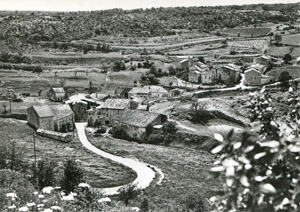
The history of our town
.png/logo-200-8900a%20(1).png)
Gallo-Roman period
Situated in the province of Narbonnaise, and more precisely in the territory of the city of Alba, the commune was on the route linking Alba to Nîmes, notably via the Rimouren valley.
The High Middle Ages
Traces of the presence of a double rampart on the Dent de Rez plateau attest to the existence of a population in the commune from the end of Antiquity and the beginning of the Middle Ages. This location was probably used to control passageways between the Rhône valley and the Ibie valley. Not far from there, the Chastelas de Baravon site, with its remains of dry-stone construction, shows human occupation as far back as the High Middle Ages; certain excavations suggest a human presence as far back as Antiquity.
The Late Middle Ages
From the 11th century onwards, the great families of the local aristocracy, as well as the bishopric of Viviers, helped to build several castles in the region. At the end of the 12th century, the Balazuc family built the castle in the village of Gras, where the famous Dame Vierne stayed.
The settlement then changed. Initially scattered, the population now gathered at the foot of the castle, forming a complex known as a "castrum". There were several reasons for this change: on the one hand, the desire to protect the population; on the other, the desire to increase the lords' income by placing the people directly under their control.
The fortification of the village of Gras enabled it to prevent any attacks by mercenary troops during the Hundred Years' War.
The Wars of Religion in the 16th century
The village of Gras underwent a succession of Catholic and Protestant occupations during this period.
In February 1573, Captain Baron's Protestant troops took possession of the village. In September 1574, Captain Laval's Catholic garrison regained possession of Gras. However, the inhabitants soon refused to pay their contributions, claiming that the costs incurred in maintaining the garrison were too high, and that they wanted above all to protect themselves.
1575 was a difficult year; the inhabitants suffered severe famine and were forced to sell the tiles and planks from their houses to merchants in Aubenas.
In 1576, following the Edict of Baulieu (also known as the "Peace of Monsieur") signed by King Henry III, the Treaty of La Borie led to a truce lasting around ten years between Catholics and Protestants in the Vivarais region.
In January 1587, following the betrayal of certain inhabitants, the village of Gras was taken over by Huguenot (Protestant) opponents. The village was finally liberated on 13 May by the Catholic captain La Baume, after a battle that resulted in the death of around twenty Huguenot resistance fighters.
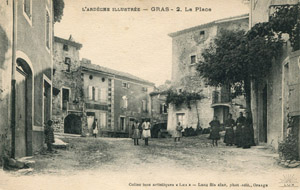
From the 19th century to the present day
The commune of Gras and the entire surrounding plateau experienced a period of over-exploitation during the 19th century. There were two reasons for this: firstly, power was in the hands of the notables, who developed a strong local economic liberalism; and secondly, there was a population surge, which reached its peak in 1860, when there were no fewer than 1,330 inhabitants.
The charcoal industry took off with the arrival of many Italian immigrants. The aim was to supply large cities like Marseille with charcoal. There was also a great deal of land clearance and the introduction of terraced farming and extensive pastoralism.
Unfortunately, 1870 marked the end of a "golden era". Phylloxera wiped out the vineyards and the silkworm disease ruined cocoon producers and spinners. Added to this was a decline in forestry revenues.
A brutal depopulation followed, lasting until the 1960s, when the number of inhabitants fell to just 362 (1954 census).
The approach of the 1st World War changed the way the plateau's natural space and resources were used. Due to a lack of resources, farmers were slow to embrace modern technology. They did, however, try to make the most of local produce, such as lavender. In the 1920s, Gras owned 3 wild lavender (aspic) distilleries.
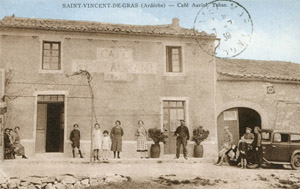
Although pastoralism was still very much alive in the 20th century, it continued to decline. The number of sheep in Gras fell from 5,000 in the mid-19th century to less than 1,600 in 1940. The charbonnières became rarer, until they disappeared in the 1970s. A victim of market forces, Gras saw its economy collapse; many farms disappeared; many inhabitants left the commune and schools such as Rimouren closed.
During the Second World War, the inhabitants of Gras were requisitioned to build the German camp on the Plaine d'Aurèle: a radar station that the German garrison dynamited before fleeing.
On 23 August 1944, a fierce battle took place between Les Hellys and the village, pitting the 7107th company of the FTP against a German column moving up from the Cévennes towards the Rhône valley.
Many refugees from the Spanish Civil War joined groups known as GTEs (Groupe de Travailleurs Etrangers); the 160th GTE, assigned to water and forestry, worked between Les Sallèles and the village of Gras. These workers were housed in the hamlets of Baravon, Chantayre and Mareval, in abandoned houses or wooden barracks.
After experiencing an extraordinary demographic boom until 1861, the commune of Gras went into steep decline, losing almost three quarters of its population in the first half of the 20th century.
Fortunately, the boom in tourism, the improvement in road infrastructure, the extension and modernisation of the various networks (water, electricity, etc.) and the creation of a community policy have given this commune a new appeal, enabling new families to settle here. The creation of a school for more than 80 children, in a teaching cluster with the municipality of Larnas, bears witness to this revival.